집블로그Gantry Cranes Wind Resistance Compliance: A Complete Guide to Global Major Standards
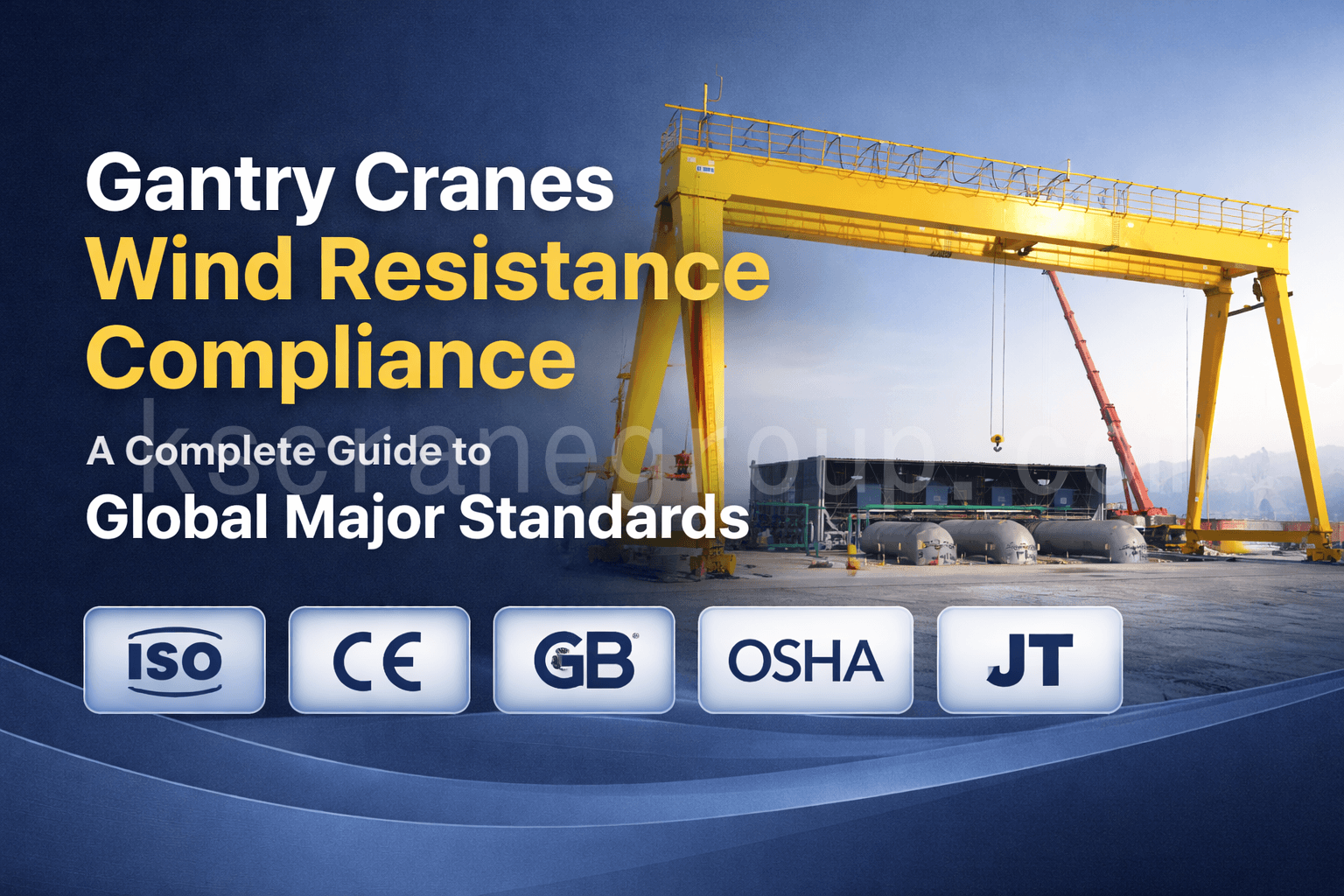
Gantry Cranes Wind Resistance Compliance: A Complete Guide to Global Major Standards
Date: 16 4월, 2026
For purchasers, equipment managers and on-site operators of gantry cranes, the gantry cranes wind resistance safety of outdoor gantry cranes relies entirely on national wind resistance standards for cranes. These standards serve as the legal basis, compliance bottom line and operating rules for all wind protection measures.
From the selection and configuration of wind resistance devices, setting of wind speed control thresholds, compliance judgment of equipment acceptance and liability determination after accidents, to daily wind resistance operations by frontline operators, all procedures must strictly comply with special wind resistance standards.
Choosing the wrong wind resistance standards or failing to implement requirements in accordance with regulations will result in equipment failing acceptance checks and project delays in mild cases. In severe cases, it may lead to heavy regulatory penalties, wind-induced overturning accidents and corresponding legal liabilities.This article focuses on special wind resistance standards for gantry cranes, helping practitioners in all positions quickly clarify standard boundaries and grasp key compliance rules to avoid violations and risks.
Why Are Special Wind Resistance Standards for Gantry Cranes an Unbreakable Bottom Line?
For purchasers of gantry cranes: They are core hard indicators for equipment acceptance
Whether for domestic project bidding or equipment export to the EU, North America, and Southeast Asia, tender documents and local market supervision will clearly specify the mandatory special standards that gantry cranes must comply with for gantry cranes wind resistance.
Gantry cranes with improper wind resistance device configuration or insufficient windproof design capacity will directly fail project acceptance. Even with excellent performance in other aspects, such gantry cranes cannot be put into use. They may even be rejected at customs or disqualified in bidding, resulting in total loss of early investment.
For equipment managers and users: They are the legal basis for full-life-cycle wind resistance management
Special equipment supervision and occupational safety regulations worldwide take the implementation of wind resistance standards as the core criterion for liability investigation in wind damage accidents.
Failure to meet standard requirements in daily wind resistance inspection, maintenance and testing will not only lead to regulatory penalties. In the event of sliding or overturning accidents of gantry cranes, responsible parties will bear primary management liability.
For on-site operators: They are life-saving red lines for daily operation
All global wind resistance special standards clearly define unbreakable wind speed control thresholds and emergency windproof operation requirements.
Standards specify exactly when to shut down gantry cranes and under what conditions wind fixing measures must be activated. These are the only legal guidelines for operators to protect their own safety and avoid operational liabilities.
Global Core Wind Resistance Standards for Gantry Cranes: Key Mandatory Requirements
ISO Wind Resistance Standard System: Universal Benchmark for Global Projects
As the top-level global framework issued by the International Organization for Standardization, it serves as the fundamental benchmark for gantry cranes wind resistance design in most cross-border projects and international tenders, and is also the core reference for countries to formulate their own wind resistance standards for gantry cranes.
Core application scenarios: global cross-border projects, international tenders, overseas aid projects by Chinese enterprises
Key mandatory wind resistance requirements
ISO 10300-3:2015 specifies calculation rules for wind loads on gantry cranes in both operating and non-operating conditions, providing the core calculation basis for wind resistance design.
ISO 4301-1:2018 mandates that outdoor gantry cranes must be equipped with wind speed monitoring and windproof interlock devices, defining basic safety requirements for wind protection equipment.
ISO 10300-1:2015 sets out core design criteria for gantry cranes against sliding and overturning. It requires wind resistance design for non-operating conditions to be based on the maximum wind speed occurring once in 50 years, while the maximum design wind speed for operating conditions shall not exceed 20m/s (Grade 8 wind).
EU EN Wind Resistance Standard System: CE Compliance Threshold for EU Market
This harmonized standard is enforced across the EU and serves as the core legal basis for CE certification, which gantry cranes must obtain to enter the EU market. Gantry cranes wind resistance provisions are mandatory inspection items in the certification process.
Core application scenarios: 27 EU member states and European regions recognizing CE certification
Key mandatory wind resistance requirements
EN 13135:2013+A1:2018 is the European crane safety standard. It specifies design and selection requirements for crane components, aiming to protect personnel from health and safety hazards and ensure reliable operation of gantry cranes. It stipulates measures to mitigate storm consequences for cranes, including limiting of overturning moment devices.
EN 15011:2020 is the core mandatory standard for the design of bridge and gantry cranes in the EU. It focuses on full-life-cycle safety and operational reliability, regulating structural strength, operational stability and safety protection. It meets the requirements of heavy-duty lifting in high-wind port environments and EU safety regulations, serving as a mandatory compliance basis for equipment entering the EU market.
2006/42/EC Machinery Directive lists gantry cranes wind resistance safety as a core mandatory item for the mechanical safety of gantry cranes. It requires identification and elimination of risks such as sliding, overturning and collision caused by wind loads, covering risk prevention, overall stability, control system safety and risk alarms — all mandatory entry requirements for CE certification.
North American ASME/OSHA Wind Resistance Standards: Legal Baseline for North American Market
Consisting of U.S. federal occupational safety regulations and industry mandatory standards, they serve as both market access criteria and legally binding requirements for gantry cranes wind resistance management and accident liability of gantry cranes in the United States.
Core application scenarios: The United States, Canada, and American regions recognizing North American standards
Key mandatory wind resistance requirements
OSHA standards stipulate that rail-mounted gantry cranes located outside enclosed buildings must be fitted with windproof rail clamps for use in strong winds, which shall activate automatically at preset wind speeds to prevent track instability caused by high winds.
ASME B30.2-2022 specifies mandatory requirements for the performance, inspection and configuration of wind protection devices on gantry cranes, and defines interlocking rules between windproof equipment and the emergency stop system of gantry cranes.
OSHA 1910.179 sets requirements for crane design and safe operation to reduce operational risks and protect workers around lifting equipment. It explicitly requires outdoor yard gantry cranes to be equipped with automatic rail clamps. In addition, wind speed indicators must be installed to provide visual or audible alarms to operators when wind speeds reach preset values. If rail clamps are applied to the rail head, any protrusions or welding flash on the rail head must be ground smooth. Regular inspection requirements for wind protection devices on in-service gantry cranes are also specified.
China GB/JT Wind Resistance Standards: Mandatory Criteria for Chinese Market
These are the core mandatory standards for the production, operation and inspection of gantry cranes in China, covering general gantry cranes wind resistance standards and port-specific wind resistance standards, serving as the sole basis for domestic special equipment licensing and acceptance inspections.
Core application scenarios: Chinese domestic market and general overseas projects by Chinese enterprises
Key mandatory wind resistance requirements
GB/T 23723.5-2025 governs the safe use of cranes in China. It specifies that crane operation in weather conditions shall comply with Clause 11.6 of GB/T 23723.1-2009. Gantry cranes shall not operate when wind speed exceeds values specified in the operation manual. Extra caution is required when moving loads to strong suction areas, even in light winds. Wind speed limits during installation, commissioning and dismantling shall be lower than those for normal operation. Consult a designer or authorized engineer in case of uncertainty. Testing shall not be conducted in regions known for abnormal weather.
JT/T 90-2020 is the industrial standard specifically for port gantry cranes against wind. It defines the wind load calculation formula for port handling machinery:
Pw = C × Kb × q × A
어디
Pw = wind load acting on gantry cranes (N)
C = wind shape coefficient
Kb = wind pressure height variation coefficient
q = calculated wind pressure (N/m²)
A = windward area perpendicular to wind direction (m²)
This formula provides the core basis for windproof device selection and structural design. The standard also specifies requirements for windproof device configuration, safety management, and a design basis based on the 50-year return period maximum wind speed for port applications. It details typhoon preparedness and response measures, especially for rail-mounted gantry cranes:
Return to and secure at anchorage positions, engage anti-slip brakes, connect and tension windproof cables or tie-rods.
Lift lifting slings to the designed windproof position and tighten anti-swing cables if equipped.
Park and lock the operator’s cabin and trolley at designated positions.
Apply iron wedges, wheel clamps, rail clamps and rail jacks if installed.
GB 6067.1-2010 requires outdoor gantry cranes to account for wind effects in both operating and non-operating conditions, with basic configuration requirements for windproof devices and safety management rules.
그만큼 Guidelines for Gust and Typhoon Prevention of Large Port Machinery issued by the General Office of the Ministry of Transport of China serves as the official enforcement basis for gantry cranes wind resistance of gantry cranes at Chinese ports and terminals. It targets typhoons and extreme gusts, detailing full-process windproof requirements as a specialized implementation of national standards in port scenarios, covering daily operation, gust/typhoon emergency response and safety management of rail-mounted gantry cranes.
Mandatory windproof measures:
Shutdown and anchoring: move to anchorage zones after operation or upon early warning, and simultaneously activate rail clamps, rail jacks, iron wedges and other devices.
Structural posture: retract and secure front beams, lift slings to windproof height, and park and lock trolleys and cabins.
Device maintenance: regularly inspect effectiveness of windproof systems; coastal ports designed for 35m/s, inland waterways for 30m/s.
Emergency response: immediate shutdown and on-site windproof protection with personnel evacuation upon gust alerts; full anchoring before typhoon landfall.
Electrical safety: cut off operational power when leaving the cabin, retaining only power for windproof early warning and monitoring systems.
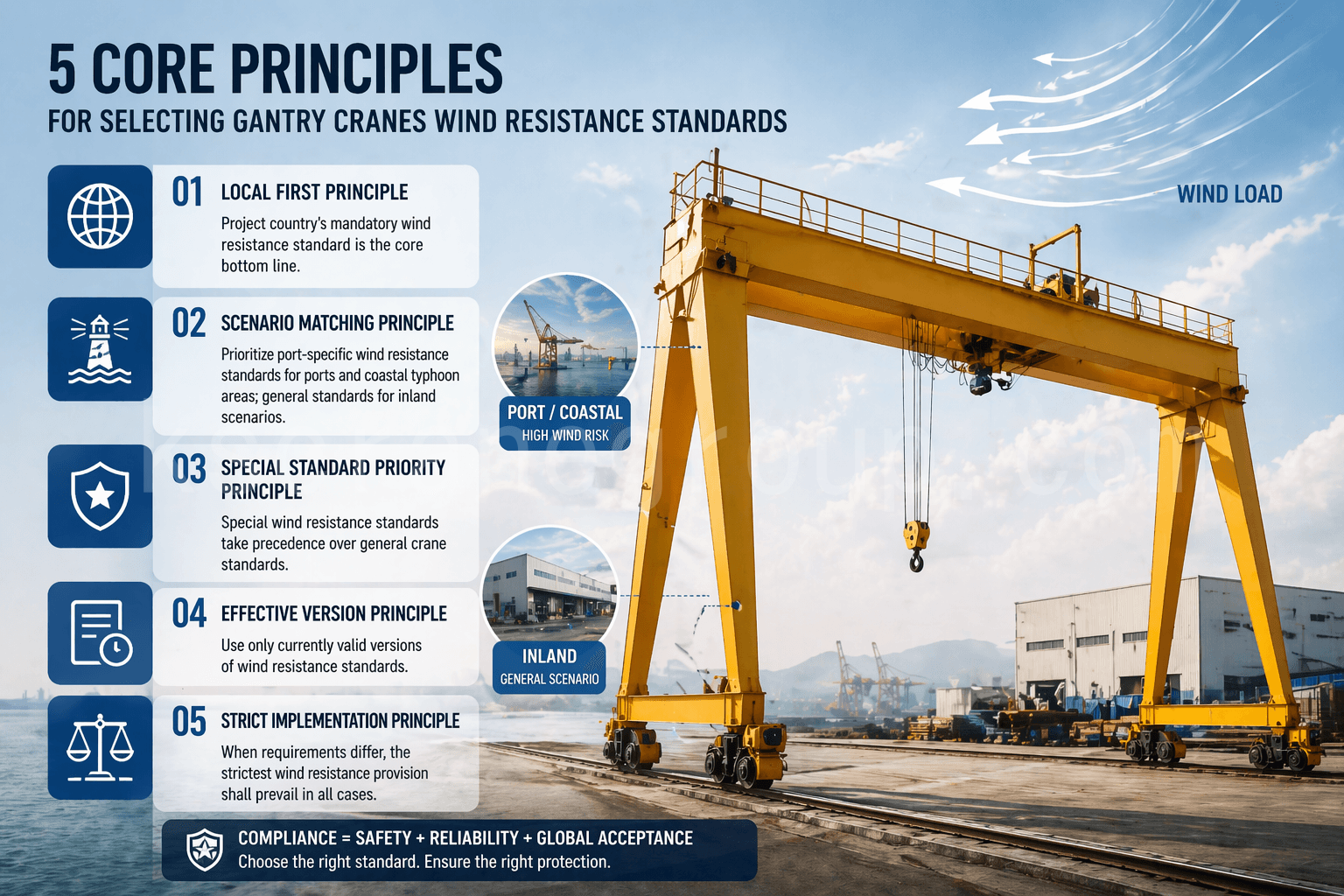
5 Core Principles for Selecting Wind Resistance Standards for Gantry Cranes
Local Priority Principle
Take the mandatory wind resistance standards of the country where the project is located as the core bottom line. International general standards are only supplementary. It is strictly prohibited to directly use Chinese wind resistance standards to replace the mandatory wind resistance standards of the exporting country.
Scenario Matching Principle
For projects in ports and coastal typhoon-prone areas, port-specific wind resistance standards must be prioritized. For general inland scenarios, general gantry crane wind resistance standards can be applied.
Specialized Standard Priority Principle
Special wind resistance standards take precedence over general crane standards. Compliance must be based on specialized wind resistance provisions as the core. It is strictly prohibited to use only general standards to bypass specialized wind resistance requirements.
Valid Version Principle
Only currently valid versions of wind resistance standards shall be adopted. Obsolete or expired editions are strictly forbidden to avoid invalid compliance.
Strict Implementation Principle
When project tender documents, local national standards and international general standards impose different wind resistance requirements, the strictest wind resistance provisions shall be applied in all cases.
Conclusion: Key Compliance Points for Windproof Standards of Gantry Cranes
There is no room for luck when it comes to the gantry cranes wind resistance safety of gantry cranes. All configurations of windproof devices, daily windproof operations, and full-life-cycle windproof management must be anchored to the mandatory requirements of the corresponding special wind resistance standards. This is not only the core to avoid market access risks and legal liability risks, but also the fundamental to protect the safety of equipment and personnel.
As a professional gantry crane manufacturer deeply rooted in the global market, all products of KUANGSHAN CRANE strictly comply with the world’s mainstream special wind resistance standards. We can provide one-on-one wind resistance standard adaptation and compliance solutions for different countries and scenarios, helping you avoid access risks and safety risks from the source.
크리스탈
크레인 OEM 전문가
8년간의 리프팅 장비 맞춤 제작 경험을 바탕으로 10,000명이 넘는 고객의 사전 판매 질문과 우려 사항을 해결해 드렸습니다. 관련 요구 사항이 있으면 언제든지 저에게 연락해 주세요!