Overhead Crane Shackle Safety and Selection Guide — ISO 2415:2022 Types, Grades, and 11 Safety Rules

Date: 30 Jun, 2026

Overhead Crane Shackle Safety explained with ISO 2415:2022 and GB/T 25854 requirements. Learn shackle types, grade differences, WLL ratings, marking requirements, inspection methods, side-loading limits, temperature derating, and the 11 essential safety rules to ensure safe overhead crane lifting and compliant rigging practices.

A shackle is the most common connection point in any overhead crane lifting assembly — linking wire ropes to slings, slings to spreader beams, and spreader beams to the crane hook. When every connection in the load path depends on a forged steel body and a threaded pin, getting the details right is not optional.

Standards context: China’s current national standard GB/T 25854-2010 is identical to (IDT) ISO 2415:2004, which uses a 4/6/8 grade system. ISO 2415:2022 replaced this with a 6/8/10 grade system, adjusted preferred dimensions and heat treatment requirements, and incorporated shackle safety rules directly into the standard as Annex B. No revision of GB/T 25854 has been registered yet, so both the current Chinese standard (4/6/8) and the latest ISO (6/8/10) are referenced here.

1. Overhead Crane Shackle Types by Body Shape

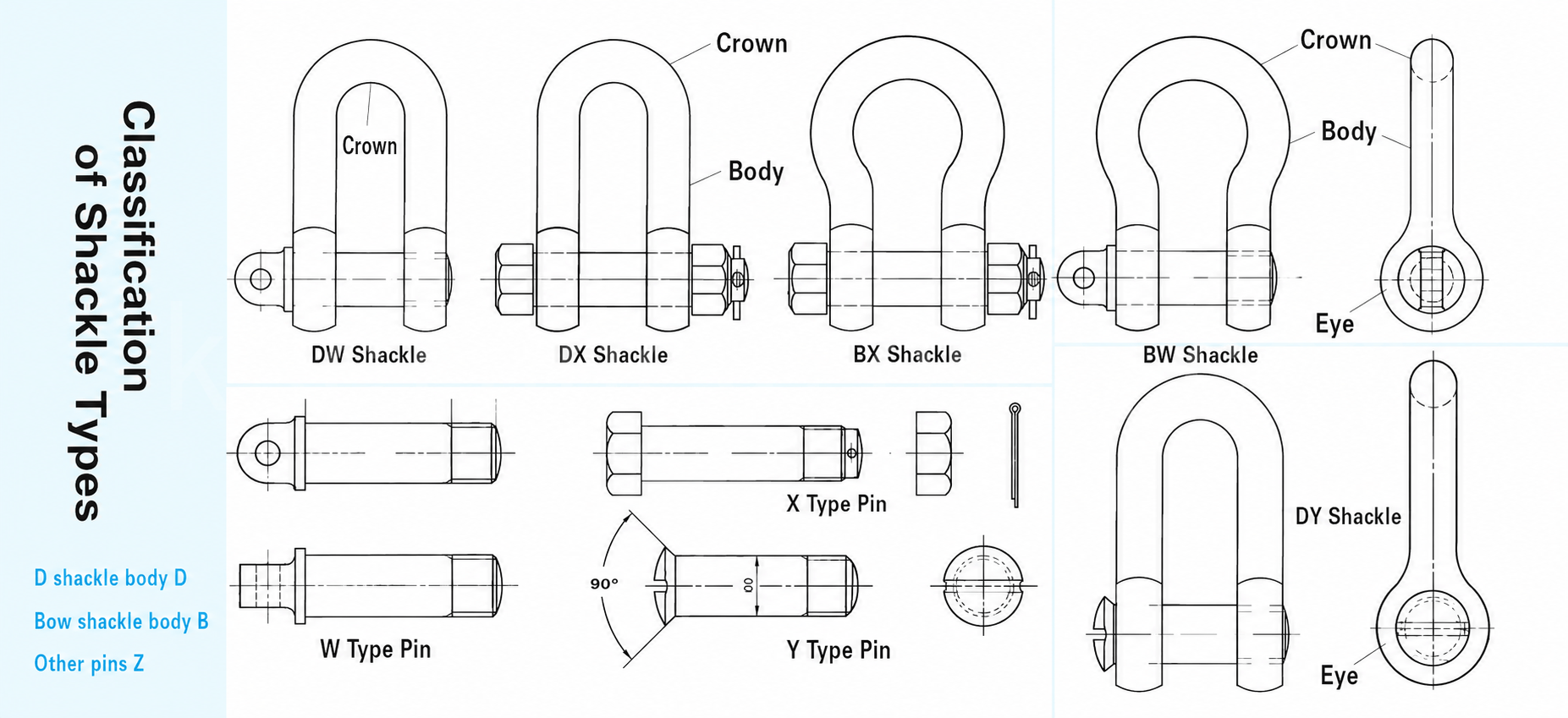
Shackle bodies are forged or cast from high-strength alloy steel (carbon steel, stainless steel), with surface treatments including hot-dip galvanizing, powder coating, or Dacromet for corrosion protection. The pin must maintain a precision fit with the body bore.

TypeDesignBest ForLimitation
Bow Shackle (B)Wide, rounded bodyMulti-directional loads, larger angular offsets, connecting multiple slingsSlightly lower strength-to-weight ratio than D-type
Dee Shackle (D)Narrow, straight-sidedStraight-line pulls, fixed-end connectionsNot designed for side loading
Flat ShackleCross-section width significantly greater than thicknessConfined spaces, light-duty lifting, marine anchor chainsLower capacity range
Large-Tonnage Round-SectionCircular or elliptical cross-section, heavier pin diameterExtreme loads (mining, offshore, heavy infrastructure), impact fatigue resistanceHeavy and expensive
Overhead Crane Shackle Types by Body Shape Comparison Table

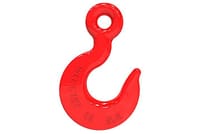
Shackles can connect directly with lifting hooks conforming to GB/T 24812 (forged eye hooks) and GB/T 24813 (forged clevis hooks).

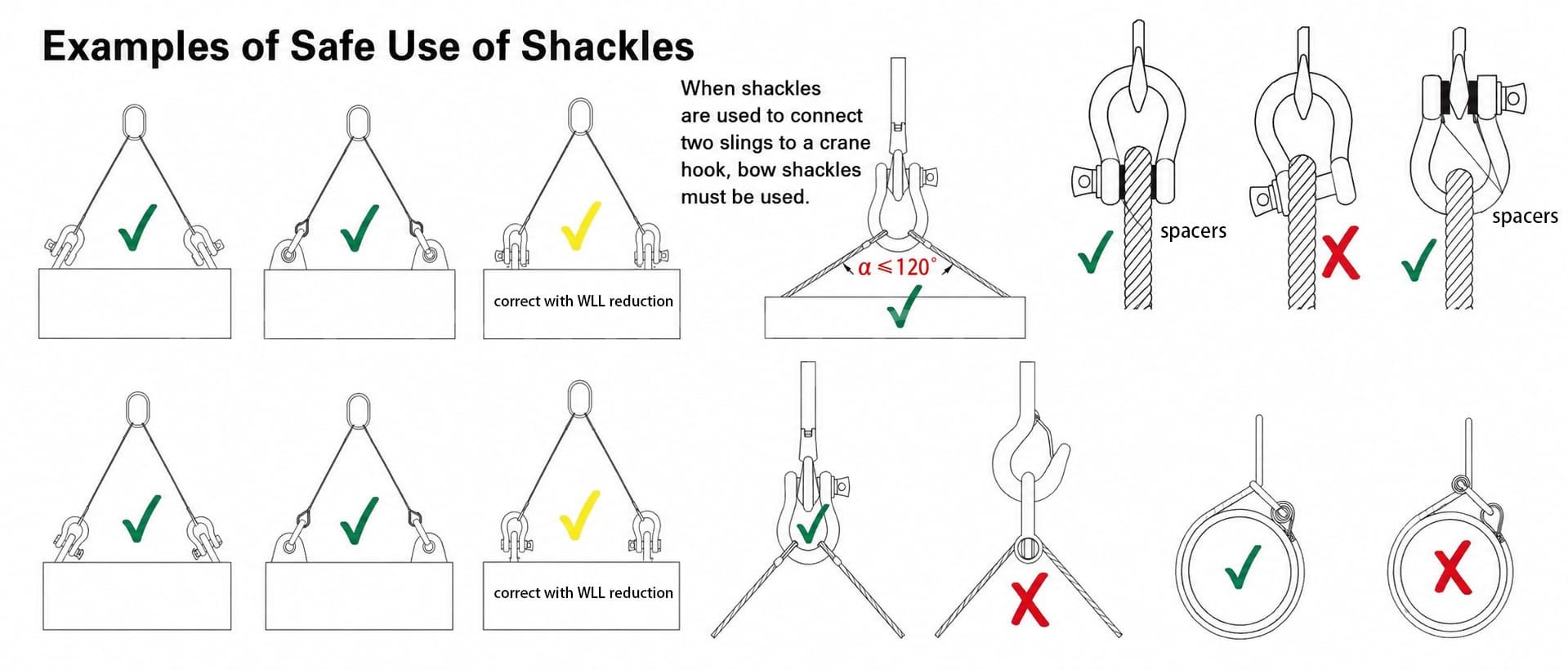
Field rule: When connecting two slings to one crane hook, always use a bow shackle. Slings go in the body, hook engages the pin. Keep the included angle between slings below 120° — wider than that and the load on each leg multiplies dramatically.

2. Shackle Types by Pin Configuration

TypeCodeMechanismUse Case
Bolt-TypeWThreaded pin with collar and step; requires wrench tighteningPermanent or semi-permanent connections, high safety requirements
Cotter-TypeXHex bolt + hex nut + split pinGeneral use, easier inspection
Screw-TypeYCountersunk head + slotted screwLight-duty, less common
CustomZManufacturer-specific designSpecial applications only
Shackle Types by Pin Comparison Table

For critical lifts or long-term installations, bolt-type (W) pins are recommended. The extra 30 seconds of wrench time is inexpensive insurance. For permanent rigging or applications where pin security is paramount, X-type pins with nut and split pin provide the most secure connection.

3. How to Read an Overhead Crane Shackle Designation

Shackle GB/T 25854 – 6 – DW20

  • 6 — Grade 6 (also available: Grade 4, Grade 8 per GB/T 25854-2010)
  • D — Dee body (B = Bow body)
  • W — Threaded pin with collar and step (X = hex bolt + nut + split pin; Y = countersunk + slotted screw; Z = manufacturer-specific)
  • 20 — WLL = 20 tonnes

WLL (Working Load Limit) is the maximum mass a shackle can support under general operating conditions. This is distinct from WL (Working Load), which is the maximum mass under SPECIFIC operating conditions — accounting for side loading, temperature, dynamic effects, and other application-specific factors.

4. Marking Requirements

Every shackle must carry permanent, legible markings applied by a method that does not impair mechanical properties.

Minimum markings on the body:

  1. Manufacturer’s trademark or identifier
  2. Grade code (4 / 6 / 8 per GB/T 25854; 6 / 8 / 10 per ISO 2415:2022)
  3. WLL (format: WLL 10 t)
  4. Traceability code (batch/lot identification)

Pin markings:

  • Pins ≥ 13 mm diameter: grade code + manufacturer’s mark
  • Pins < 13 mm diameter: grade code minimum

If you cannot read the markings, do not use the shackle.

5. The 11 Overhead Crane Shackle Safety Rules — ISO 2415:2022 Annex B

Rule 1 — Pre-Use Inspection

Before every lift, verify:

  • Body and pin are identifiable as the same size, same model, and same manufacturer
  • All markings are legible
  • Pin and body threads are undamaged
  • No visible deformation on body or pin
  • No significant wear
  • No nicks, gouges, cracks, or corrosion on body or pin

Rule 2 — Never Mix Pins and Bodies

A pin must only be replaced with one of the same size and, at minimum, the same model and manufacturer. A mismatched pin may thread in smoothly but fail under load.

Rule 3 — Avoid Side Loading

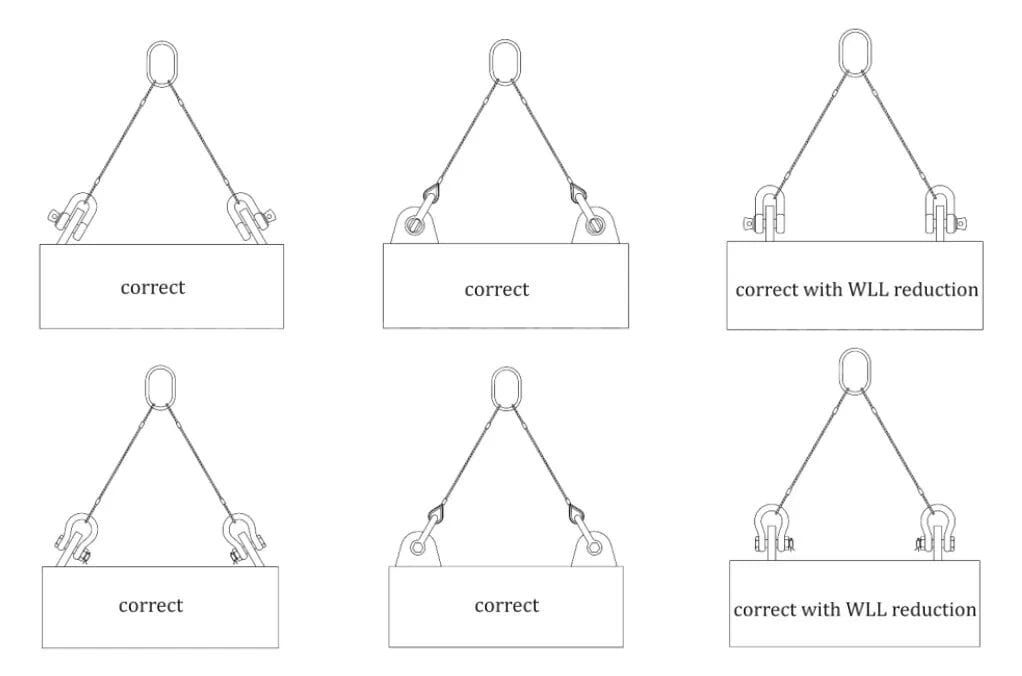
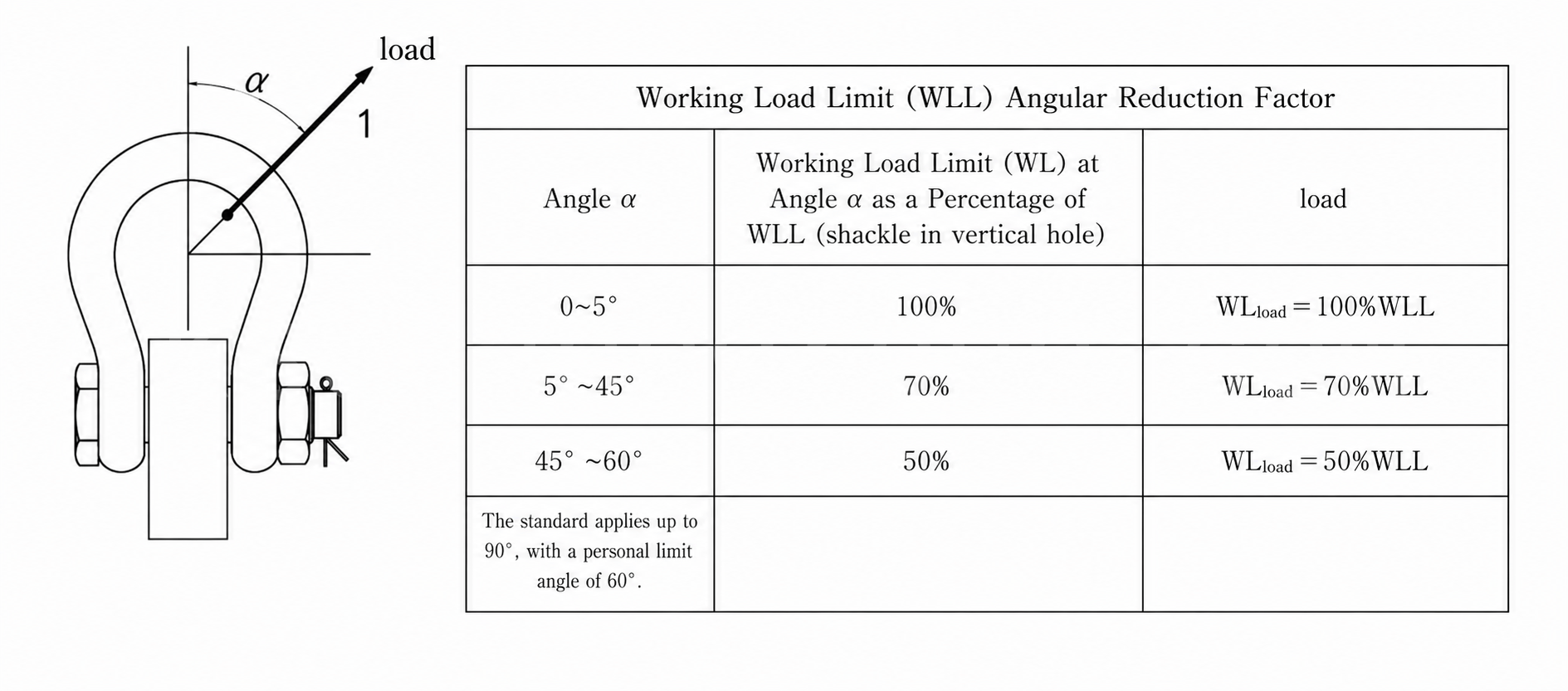
Position lifting eyes so the shackle is loaded in-line. Side loading drastically reduces capacity.

3Position lifting eyes so the shackle is loaded in line

If side loading cannot be avoided, derate the WLL according to the reduction table in the standard.

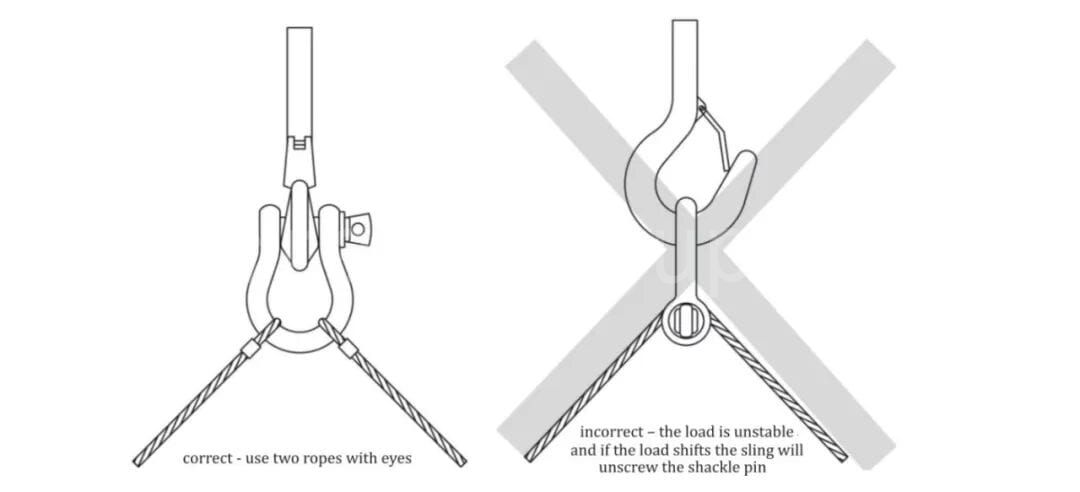
Rule 4 — Two-Leg Sling Connections: Bow Shackle Only

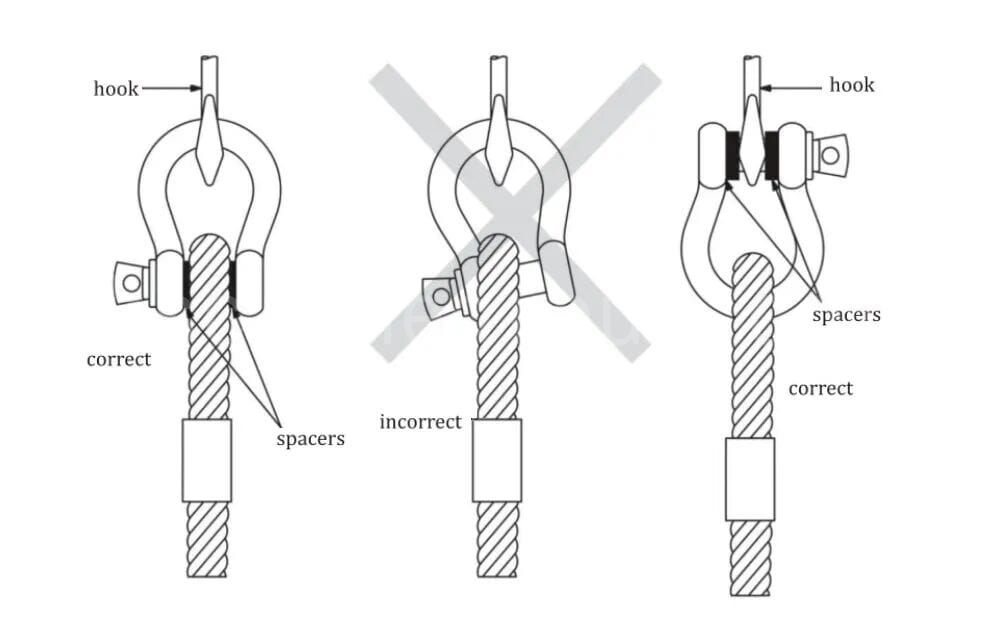
When connecting two slings to one crane hook, use a bow shackle. Slings go in the body, hook engages the pin. The included angle between slings must not exceed 120°.

5Two Leg Sling Connections

Rule 5 — Use Spacer Washers, Not Welded Spacers

To center a shackle on a lifting eye, use loose spacer washers on the pin. Never weld washers or plates to the eye to reduce jaw width — this changes the load path and compromises the shackle’s load-bearing performance.

6Use Spacer Washers Not Welded Spacers

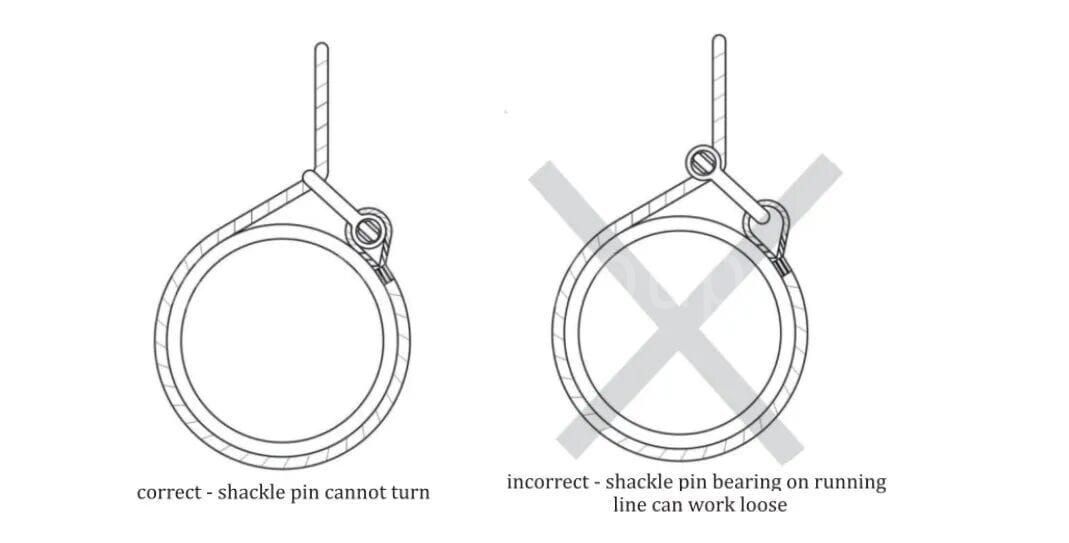
Rule 6 — Prevent Pin Rotation Under Load

Avoid applications where load movement or rope motion could cause the pin to roll and unscrew. With bolt-type pins, once the pin starts backing out under cyclic loading, failure is a matter of time.

7Prevent Pin Rotation Under Load

Rule 7 — Avoid Unstable Load Configurations

If the load can shift, tilt, or rotate during the lift, the shackle may experience unexpected bending moments. Rig so the load is stable and the shackle sees tension only.

8Avoid Unstable Load Configurations

Rule 8 — Use X-Type Pins for Critical Installations

For permanent rigging or applications where pin security is paramount (suspended platforms, long-duration lifts), X-type pins with hex bolt, nut, and split pin provide the most secure connection.

Rule 9 — Temperature Derating

Shackles lose strength at elevated temperatures. Apply the following WLL reductions:

Temperature RangeWLL
-20°C to 200°C100% of rated WLL
200°C to 300°C90% of rated WLL
300°C to 400°C75% of rated WLL
Above 400°CDo not use
Temperature vs. WLL Weight Reduction Comparison Table

For temperatures outside -20°C to 400°C, consult the manufacturer.

Rule 10 — Chemical Exposure

Never immerse shackles in acid solutions or expose them to acid fumes or other chemicals without manufacturer approval. Even atmospheric corrosion in chemical plants can cause hydrogen embrittlement in high-strength alloy steels.

Rule 11 — Periodic Inspection (6-Month Maximum)

All shackles in service must undergo thorough periodic inspection by a competent person. The interval depends on frequency of use and severity of the environment, but must not exceed six months. Any shackle showing illegible markings, visible deformation, thread damage, wear exceeding 10% of original cross-section, cracks, or corrosion pitting must be removed from service immediately.

Standards Referenced(Query of Chinese Crane Standards):

  • ISO 2415:2022 — Forged shackles for general lifting purposes — Dee shackles and bow shackles (current international standard; 6/8/10 grade system, Annex B safety rules)
  • GB/T 25854-2010 — Shackles, Dee and Bow, for General Lifting Purposes (IDT ISO 2415:2004; 4/6/8 grade system; currently in force in China)
  • GB/T 24812 — Forged Steel Lifting Hooks with Eye
  • GB/T 24813 — Forged Steel Lifting Hooks with Clevis

Sourcing note: If your supplier quotes GB/T 25854-2010, the shackle is built to the 2004 ISO version with 4/6/8 grades. If they claim ISO 2415:2022 compliance, expect the updated 6/8/10 grade system and Annex B safety rules. Verify which standard applies before procurement.

Krystal
krystal
Crane OEM expert

With 8 years of experience in customizing lifting equipment, helped 10,000+ customers with their pre-sales questions and concerns, if you have any related needs, please feel free to contact me!

TAGS: Crane Lifting,Forged Shackles,GB/T 25854,ISO 2415:2022,Lifting Equipment Inspection,Lifting Shackles,overhead crane,Rigging Safety,Shackle Safety,Working Load Limit
English
Español Português do Brasil Русский Français Deutsch 日本語 한국어 العربية Italiano Nederlands Svenska Polski ไทย Türkçe हिन्दी Bahasa Indonesia Bahasa Melayu Tiếng Việt 简体中文 বাংলা فارسی Pilipino اردو Українська Čeština Беларуская мова Kiswahili Dansk Norsk Ελληνικά English