Overhead Crane Wire Rope Sizing Without Tables — A Field Engineer’s Quick Formula Method

Date: 30 Jun, 2026

When you are on a job site or in a project meeting and someone asks “what diameter overhead crane wire rope do I need for X tonnes?”, you may not have GB/T 20118 or ISO 2408 at hand. This article presents a coefficient-based quick formula for 6×19 and 6×36 class overhead crane wire ropes — the two families that cover over 90% of crane hoisting applications. The method has been verified against GB/T 20118-2017 standard tables with an error margin within 2%.

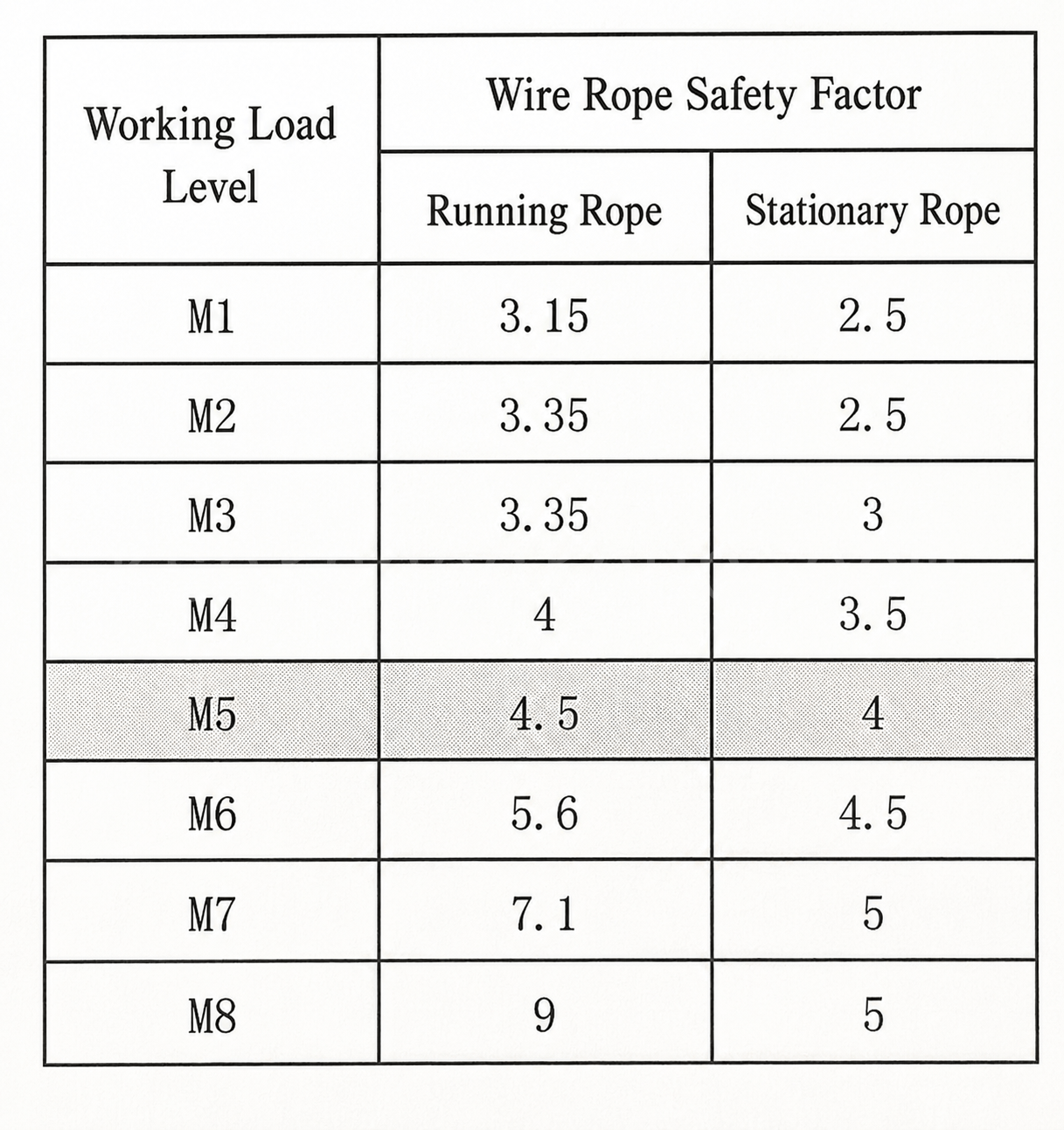
1. Determine the Overhead Crane Wire Rope Safety Factor

The safety factor is the ratio of the rope’s minimum breaking force to the total working load.

ApplicationMinimum Safety Factor
Static bracing / guy ropes (permanent tension)3
Manual hoisting equipment4
Powered hoisting equipment5–6
Crane designPer GB/T 3811 crane design code
Overhead Crane Wire Rope Safety Factor
1Determine the Safety Factor of overhead crane wire rope

For general lifting with powered equipment, default to 5 or 6. When the load involves personnel access or is suspended over critical infrastructure, go higher.

2. Identify the Overhead Crane Wire Rope Class

Class A — Linear Contact (Preferred for Crane Hoisting)

6×19 class and 6×36 class strands. Wires within each strand are arranged so contact occurs along lines rather than at points, distributing stress more evenly and delivering better fatigue life. These are the standard choice for crane hoisting mechanisms.

Common constructions: 6×19S-FC, 6×19S-IWRC, 6×36WS-FC, 6×36WS-IWRC, 6×17S, 6×21S, 6×21F, 6×26WS, 6×19W, 6×25F, 6×31WS, 6×29F, 6×37FS, 6×41WS, 6×46WS, 6×49SWS, 6×55SWS.

CodeMeaningCharacteristic
WWarrington (alternating wire sizes in outer layer)Good flexibility
SSeale (coarse outer wires)Good abrasion resistance
FFiller (small filler wires between layers)Compact structure
WSWarrington-Seale compositeBest balance of flexibility and fatigue resistance — most common in cranes
FCFiber CoreStores lubricant, more flexible
IWRCIndependent Wire Rope Core (steel)Higher breaking strength — approximately 1.08× the FC equivalent
Characteristics of The Crane Wire Rope

Class B — Point Contact (Secondary Applications)

6×19M class and 6×37M class. Wires cross at discrete points, creating stress concentrations and lower fatigue resistance. Mostly used for static guy ropes and secondary applications.

Common constructions: 6×19M-FC, 6×19M-IWRC, 6×37M-FC, 6×37M-IWRC.

3. The Quick Diameter Formula for Overhead Crane Wire Rope Sizing

For Class A, 1770 MPa tensile grade, Fiber Core — the most common overhead crane wire rope configuration:

d ≥ √(T ÷ k)

  • where: k = 0.06
  • T = safe working load per rope (tonnes)
  • d = nominal rope diameter (mm)

In plain terms: d² × 0.06 = T. The square of the rope diameter in millimetres multiplied by 0.06 equals the safe working capacity in tonnes.

Example: A 10-tonne single-part lift requires d = √(10 ÷ 0.06) = √166.7 ≈ 12.9 mm → round up to 13 mm from the standard diameter series.
The standard diameter series (mm) for Class A: 8, 9, 10, 11, 12, 13, 14, 15, 16, 18, 20, 22, 24, 26, 28, 30, 32, 34, 36, 38, 40, 42, 44, 46, 48, 50, 52, 54, 56. (6 and 7 mm exist but are rare in crane hoisting; 58 and 60 mm depend on specific construction.)

Adjusting for Different Tensile Grades

The base coefficient k = 0.06 applies to 1770 MPa. For each grade step of approximately 90–100 MPa, adjust by ±0.003:

Moving UP in grade: k_i = 0.06 + 0.003 × i

Moving DOWN in grade: k_i = 0.06 – (0.003 × i + 0.001)

Where i = 0 at 1770 MPa. The tensile grade series: 1570 → 1670 → 1770 → 1870 → 1960 → 2160 MPa.

Tensile Grade (MPa)Fiber Core kSteel Core k (= FC × 1.08)
15700.0530.057
16700.0560.061
17700.0600.064
18700.0630.068
19600.0660.071
21600.073 0.079
Crane Wire Rope Tensile Strength Depth Comparison Table

Special case for 2160 MPa fiber core: The calculated value is 0.072, but the verified coefficient is 0.073 — add an extra 0.001. This exception applies only to the 2160 grade.

Example: For 1870 MPa fiber core (i = 1), k = 0.06 + 0.003 = 0.063. The same 10-tonne load: d = √(10 ÷ 0.063) = √158.7 ≈ 12.6 mm → round up to 13 mm.

4. Rope Weight Estimation

Once the diameter is selected, approximate weight per 100 metres:

m_FC = 0.38 × d² (fiber core, Class A)

m_IWRC = 0.418 × d² (steel core, Class A)

Where m is weight (kg per 100 m) and d is diameter (mm). Weight coefficients are independent of tensile grade.

Example: 13 mm fiber core rope → m = 0.38 × 169 = 64 kg per 100 m. A 30-metre fall weighs approximately 19 kg.

5. Back-Calculating Capacity from an Existing Rope

When you encounter a rope on site with no identification — no certificate, no tag, no marking — measure its actual diameter and estimate its safe working load:

F = 0.06 × d² (tonnes, Class A, 1770 MPa, fiber core)

Example: A found rope measures 16 mm. F = 0.06 × 256 = 15.4 tonnes safe working load (assuming 1770 MPa, Class A, FC). For steel core: multiply by 1.08 → 16.6 tonnes.

Important: This back-calculation assumes a new rope in as-manufactured condition. It does not account for wear, corrosion, broken wires, or fatigue damage. Always perform a thorough visual inspection and check against discard criteria before relying on a found rope for lifting.

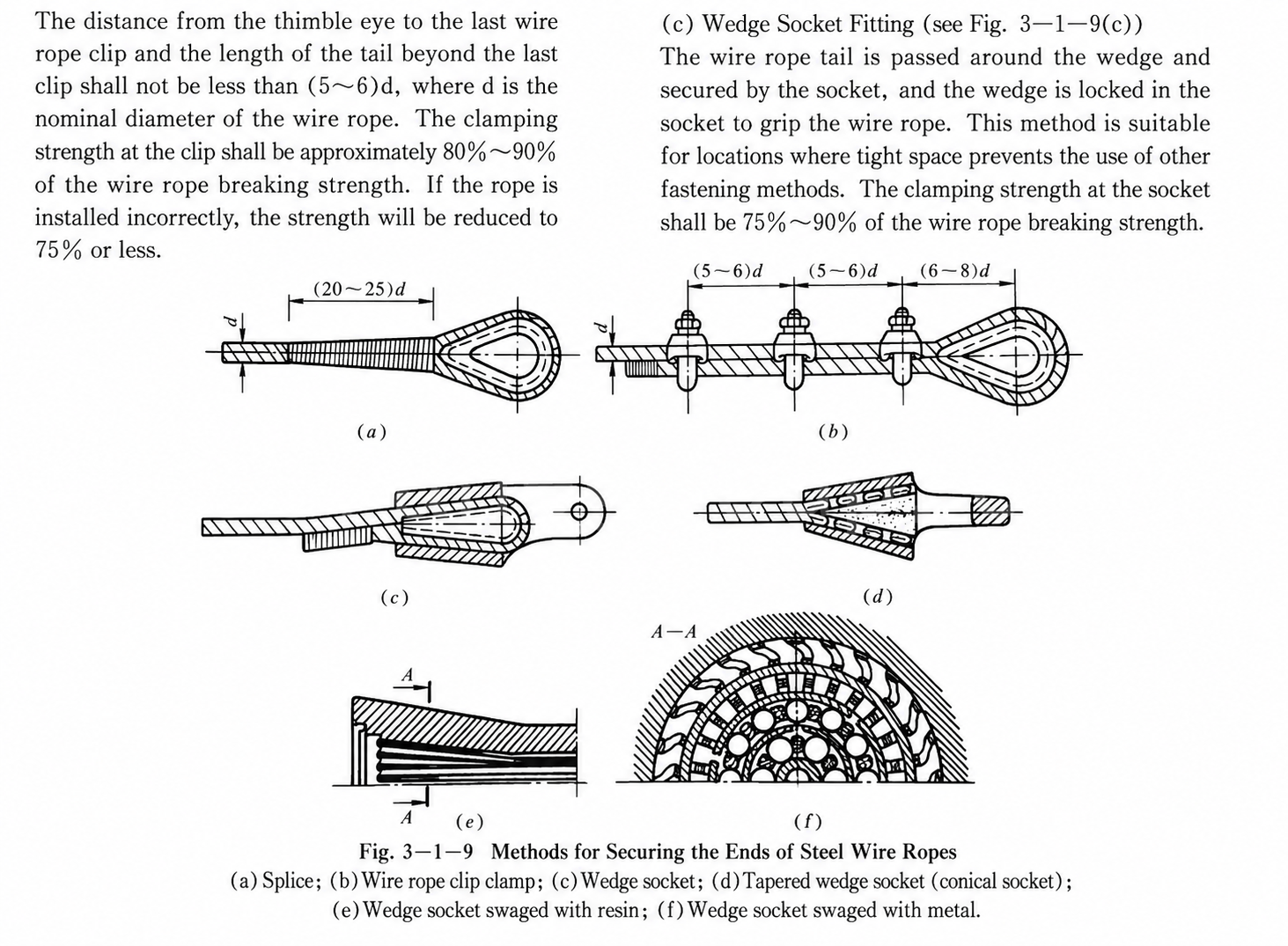
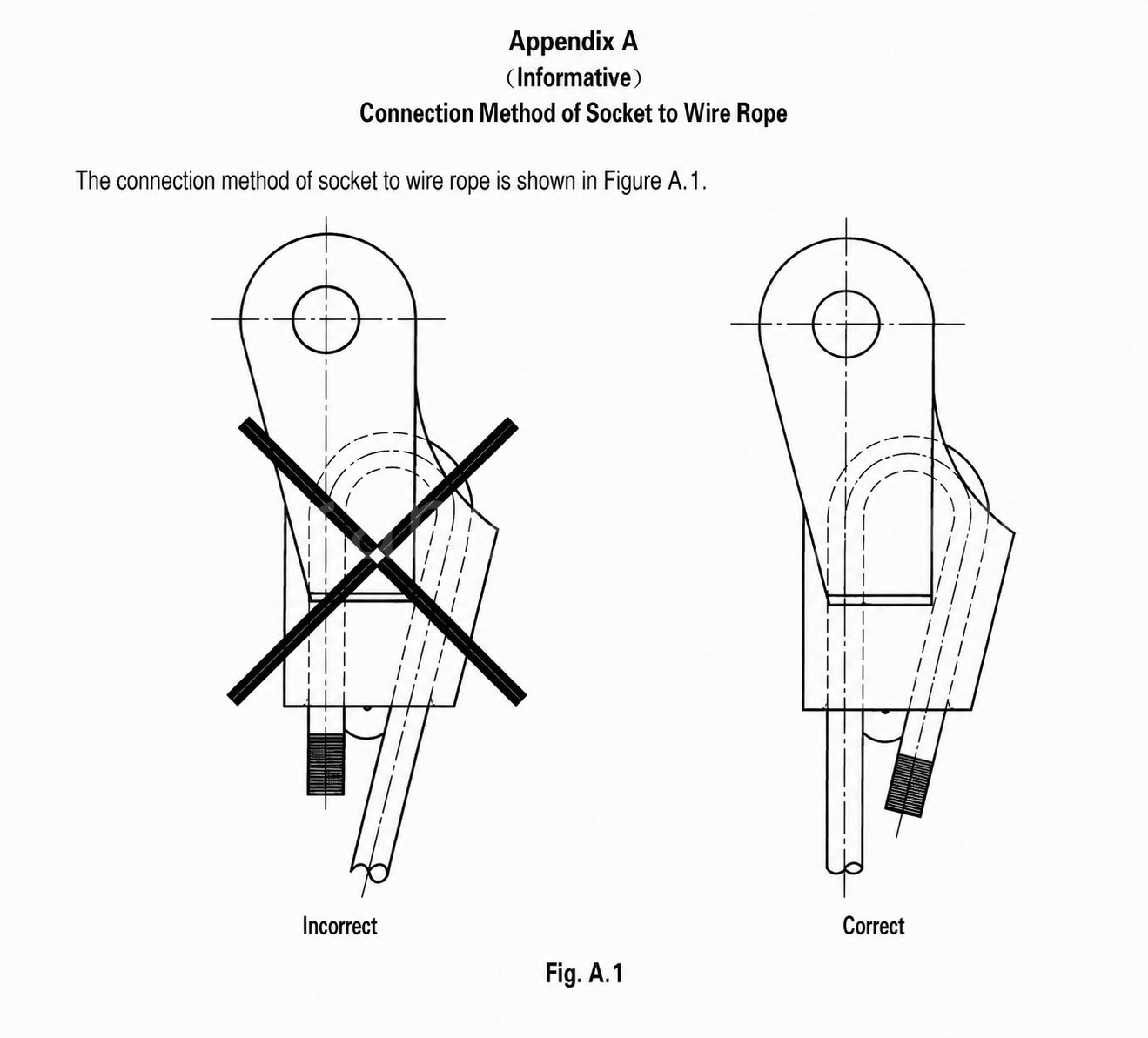
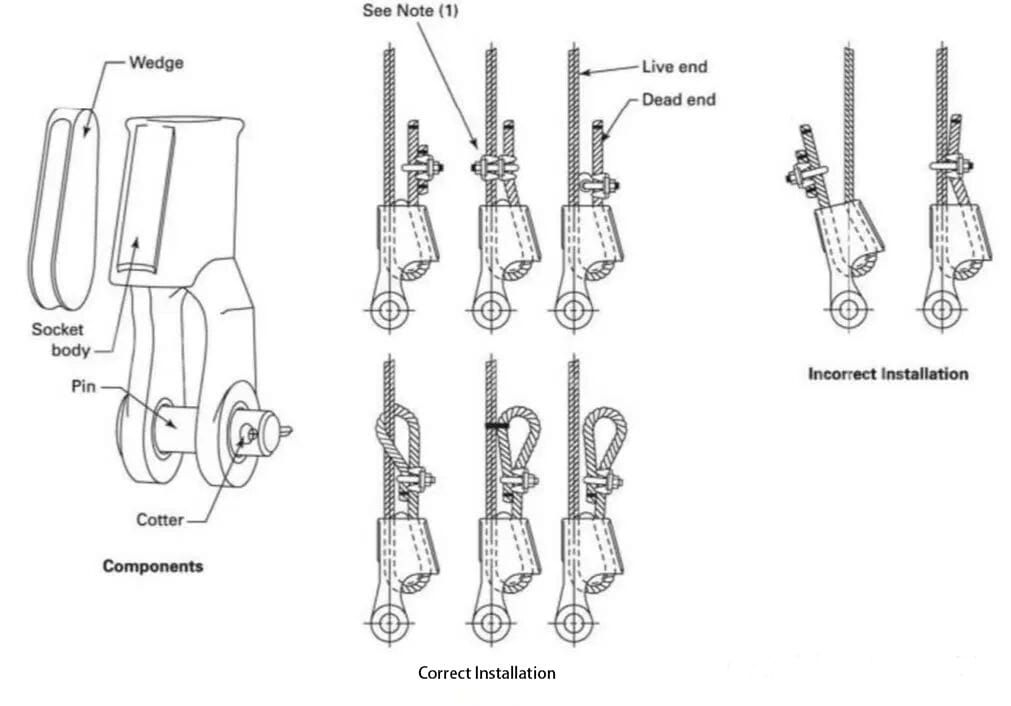
6. Overhead Crane Wire Rope End Termination Methods

2Overhead Crane Wire Rope End Termination Methods
MethodStandardKey Rule
Wire rope clipsGB/T 5976d ≤ 16 → 3 clips; 16 < d ≤ 20 → 4 clips; 20 < d ≤ 26 → 5 clips; d > 26 → 6 clips. Clip spacing = (5–6) × d
Wedge socketGB/T 5793Wrap tail tightly behind wedge; Chinese standard does not mandate a backup clip, but US practice (ASME B30.5) adds one behind the wedge for extra security
Aluminum ferrule (swaging)Requires hydraulic press; verifiable by deformation measurement
SplicingHand-spliced eye; traditional, declining in industrial use
Conical socket (poured zinc/resin)High-strength termination for large-diameter ropes
Overhead Crane Wire Rope Fixing Standard Comparison Table
3Overhead Crane Wire Rope End Termination Methods1
4Overhead Crane Wire Rope End Termination Methods2

Appendix: Class B Coefficients (Point Contact Ropes)

For 6×19M and 6×37M class point-contact ropes, which see significantly less use in crane hoisting:

ParameterSymbolValue (FC, 1770 MPa)
Base coefficientk0.053
Grade adjustmentk_i0.053 ± 0.003 × i (symmetric, no extra -0.001)
Weight coefficient (FC)w10.35
Weight coefficient (IWRC)w20.40
Safe capacity (FC)F0.053 × d² (tonnes)
Strength of Class B Crane Wire Rope

Example for Class B, 1570 MPa: k = 0.053 – (0.003 × 2) = 0.047.

Standards Referenced(Query of Chinese Crane Standards):

  • GB/T 20118-2017 — Steel wire ropes for general purposes (authoritative source for exact minimum breaking force values)
  • GB/T 5793-2006 — Wedge sockets for wire rope
  • GB/T 5976-2006 — Wire rope clips

Method accuracy: Verified against GB/T 20118-2017 standard tables. Error generally within 2% for the rope constructions covered. This is a practical field method — for final engineering specifications, always verify against the full standard.

If you want to learn more about the safety of crane wire ropes, you can read this article: Replacement and Installing Wire Rope on Crane: Key Considerations and Tips for Long-Term Durability

Krystal
krystal
Crane OEM expert

With 8 years of experience in customizing lifting equipment, helped 10,000+ customers with their pre-sales questions and concerns, if you have any related needs, please feel free to contact me!

TAGS: Crane Hoisting,Crane Maintenance,Field Engineering,GB/T 20118,overhead crane,Quick Formula,Safety Factor,Wire Rope Diameter,Wire Rope Sizing,Wire Rope Termination
English
Español Português do Brasil Русский Français Deutsch 日本語 한국어 العربية Italiano Nederlands Svenska Polski ไทย Türkçe हिन्दी Bahasa Indonesia Bahasa Melayu Tiếng Việt 简体中文 বাংলা فارسی Pilipino اردو Українська Čeština Беларуская мова Kiswahili Dansk Norsk Ελληνικά English